
11 Best Innovation and Design Books of 2010 (An Entirely Unscientific List)
11 Best Innovation and Design Books of 2010 (An Entirely Unscientific List)
11 Best Innovation and Design Books of 2010 (An Entirely Unscientific List)
From [ CORE 77 – http://www.core77.com/ ]
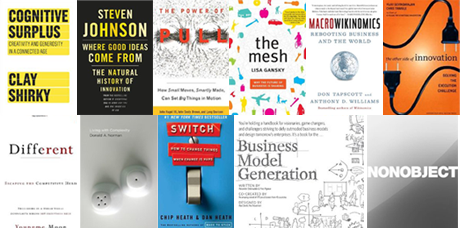
Cognitive Surplus: Creativity and Generosity in a Connected Age
Clay Shirky
Penguin Press
NYU/ITP professor, Shirky
opens his latest with a dramatic statistic: Americans watch 200 billion
hours of television every year. For Shirky, this is not a matter for
celebration. Instead, he asks, what might happen if even a fraction of
those hours were put toward more meaningful activities? Lyrically
describing the Internet as “the first public medium to have
post-Gutenberg economics”, Shirky outlines an age in which the
television is no longer the focal centerpiece of media, and recaps
various initiatives whose practitioners use the tools now widely and
often freely at their disposal to do good. From the fans of Josh Groban,
who set up a charitable foundation called Grobanites for Charity, to
the 50,000 or so members of PatientsLikeMe, who have formed communities
around various diseases, these are people stepping up to have their say.
While there’s a whiff of idealism here, this book is an important read
for anyone wondering when we might go back to the good old days. As
Shirky makes clear, we won’t. Concluding with a set of practical advice
for those looking to thrive, he emphasizes the importance of asking the
right questions and being ready to adapt. Only then will the fittest
figure out how to survive.
Where Good Ideas Come From: The Natural History of Innovation
Steven Johnson
Riverhead
Johnson opens his book
with a lyrical explanation of the 10/10 Rule, which dictates that it
takes ten years to build a new platform but another ten years for it to
build a mass audience. It’s a smart way to introduce a book which looks
to debunk the appealing but misleading idea of the lone, maverick
innovator having a lightbulb moment and plucking an idea of genius from
thin air. Instead, Johnson puts those geniuses into context. Characters
such as Charles Darwin, Tim Berners-Lee and inventor Lee de Forest are
brought to life as they struggle to make sense of their insights, with
their wrong turns proving as insightful and fascinating as their
eventual world-changing successes. Johnson reaches far and wide for
examples, many of which come from nature or biology though the corporate
world gets a look in too. Apple’s here, Google too, but this is less a
how-to cheat sheet or recap of the stories you already know than it is a
poetic and compelling look at the nature of ideas and how they take
root in individuals and society at large.
The Power of Pull: How Small Moves, Smartly Made, Can Set Big Things in Motion
John Hagel, John Seely Brown, Lang Davison
Basic Books
“There’s a new paradigm in town, and it’s called pull.” This spritely
book from legendary tech world figure John Seely Brown and his
colleagues at Deloitte’s Center for the Edge
outlines the authors’ assertion that we’re living in a brave new world.
Yes, yes, they acknowledge. We’ve heard this before–but this time it’s
really true. Honest. After a false start or two, the Internet has
emerged as a globally affecting tool and the structures of everything
from corporations to governments have changed irrevocably. But this
isn’t merely a paean to the power of the Internet. Instead, it includes a
powerful, compelling emphasis on the idea that individuals get to have a
say and an influence, even on seemingly huge problems or within huge,
sclerotic organizations. You too can shape your serendipity and destiny
and it’s up to you to harness your own potential. This is a business
book, first and foremost, with all the stylistic tics and chapter-ending
“action points” so beloved by this genre. But it’s also an
inspirational handbook outlining a provocative way to approaching life
in the modern era.
The Mesh: Why The Future of Business is Sharing
Lisa Gansky
Portfolio/Penguin
For those immersed in the world of innovation, it can be difficult to
remember a time before social media was tightly woven into every aspect
of life, affecting everything from the way we get our information to the
way we purchase goods. That means it can sometimes be difficult to
remember that there’s still an awfully long way to go before social
media tools are truly ubiquitous and really live up to all the
breathless hype. Still, great strides are made every day, and executives
are clearly paying attention. In this breezy book, serial entrepreneur Lisa Gansky
outlines her philosophy of a new environment in which many of the
principles embodied by social media will dictate the future success of
every business, large or small. Describing a corporate ecosystem based
on ideas of access rather than ownership, which she calls “the Mesh”,
Gansky lays out how far we’ve come, illustrating with analysis of poster
children companies such as Netflix and Zipcar–and sets up a compelling
outline for where we might yet go. Gansky is measured, analytical and
upfront about the challenges that lie ahead and her argument makes a
good case for why this stuff really matters. The book concludes with a
directory of existing Mesh businesses in industries from food and wine
to health and hobbies. Many will likely fail, but it’ll be interesting
to monitor how these ideas disperse to seed the successes of the future.
Macrowikinomics: Rebooting Business and the World
Don Tapscott and Anthony D. Williams
Portfolio/Penguin
“Let’s face it. The world is broken,” write the authors of this follow
up to their popular book from 2007, Wikinomics. Outlining their theory
that entirely new models of problem solving will be necessary to survive
in the modern world, this is an impressive, ambitious look at
initiatives currently underway to transform industries. Tapscott and Williams
have clearly done their homework, and come up with an exhaustive
outline of the current state of innovation within everything from
finance to healthcare to the entertainment business. With insights and
analyses of many of those driving to forge a future we can all believe
in, such as Galaxy Zoo’s Kevin Schawinski or Jay Rogers of crowdsourcing
car company, Local Motors, Tapscott and Williams are fervent
evangelists for the digitally driven movement they are describing. But,
refreshingly, they’re also open to the critics and skeptics, and smartly
include input from those with whom they disagree. One thing’s clear,
they say, “collaborative innovation is becoming a societal imperative”.
The inspiring question a reader takes away: are you in or are you out?
The Other Side of Innovation: Solving the Execution Challenge
Vijay Govindarajan, Chris Trimble
Harvard Business Review Press
Perhaps the driest book of this bunch, this book will mainly be useful
for those mired in trying to innovate within the world’s largest and,
shall we say, less than A-list corporations. Anyone familiar with the
landmines apparently hidden in every department of a big organization,
ready to blow up even the most promising seeming innovation project,
will likely relate to the challenges noted here. And even those not
directly involved in innovation would likely benefit from the scads of
practical advice on how to move a project forward. Tuck School of
Business faculty members Govindarajan and Trimble include useful
examples of challenges within corporations such as Dow Jones, ADI and
Thomson Reuters and they are specific and precise in outlining potential
systems that might provide reliable solutions to nasty problems.
Different: Escaping the Competitive Herd
Youngme Moon
Crown Business
Harvard Business School marketing innovation professor, Youngme Moon
sets up her thesis upfront: that competitive differentiation is a myth
and that by focusing so much on trying to be different, companies meekly
consign themselves to a life of staggering mediocrity. Initially
counter-intuitive, it’s an appealing theory that makes more and more
sense as Moon lays out her case. Using a ton of examples from both her
academic life and the corporate world, Moon strikes an appealing balance
in tone, both analytical and personal. For instance, she tells of a
tactic from her early teaching days, when she’d critique students’
progress and then watch, dismayed, as they promptly focused on trying to
improve in those areas, ignoring their genuine strengths. Brands do
this too, attempting to shore up spaces in which they feel vulnerable
rather than capitalizing on what they’re really good at. With smart
breakdowns of “reverse brands” (Google and Ikea remove the bloat of
pre-existing industries) and “hostile brands” (Mini, Birkenstock, Red
Bull revel in polarizing audiences), among others, her conclusion, that
differentiation is not a tactic, it is a way of thinking, should
resonate far beyond the marketing department.
Living with Complexity
Donald A Norman
The MIT Press
Former Apple executive and founder of the Nielsen Norman Group, Don Norman
has lately been causing a flutter in design circles for his defiant,
often contrarian stances on the industry (not least within these
hallowed virtual walls: see his latest for Core77, on why design education must change.)
Here comes his book-length version, in which he takes on the common
trope that we’re all craving more simplicity in our lives–and promptly
dismisses it. It’s not simplicity we need, he argues. It’s smart design
that provides users with an appropriate and thoughtful experience. The
modern age faces us with a perplexing paradox: in order for our lives to
be easier, we need more powerful and more complex tools. Norman lays
out clear examples of the difference between “featuritis”, the wanton
addition of baffling, inappropriate capabilities, and smart,
sophisticated design that users instinctively know how to use and yet
barely register mastering. What he’s not doing, he says repeatedly, is
equating complex with complicated, and he is more than happy to point
out examples of rogue design run amok. But his is a provocative theory
with its feet firmly planted in common sense: Complexity is a fact of
modern life. What else can we do but learn how to deal with it?
Switch: How to Change Things When Change Is Hard
Chip Heath, Dan Heath
Crown Business
As anyone who listened to the past few years’ worth of debate over the
restructuring of either the healthcare industry or Wall Street knows,
meaningful, lasting change is really hard to implement. That doesn’t
mean it isn’t necessary, and in this slim whirlwind of a book, the Heath brothers
(they’re both academics: Chip at Stanford; Dan at Duke) offer a series
of practical ways to implement change in your organization or your life.
They outline three main principles to abide by: “Direct the rider” to
assess a situation and come up with a bite-size plan of attack;
“motivate the elephant” to remain engaged in a problem and then “shape
the path” to remain very clear about the change you’re trying to
implement. The writing zips along at a cracking pace while the examples,
of change agents such as Robin Waters using design to transform Target
from a run-of-the-mill department store into the swanky, coveted yet
accessible Tar-jay are often familiar but nonetheless useful and
aspirational. This is a smart synthesis of thinking on a topic that
remains critical to every business practice while the Heaths are often
laugh-out-loud-funny. One passage detailing their failed attempts to
learn how to dance had me holding my sides. When was the last time you
laughed at a business book?
Business Model Generation: A Handbook for Visionaries, Game Changers, and Challengers
Alexander Osterwalder, Yves Pigneur
Wiley
By rights, this book shouldn’t feature in a round-up of the best titles
of 2010, as it first came out over a year ago. But the story of how it
came to be seen by a wider audience earns it a gold star and a place on
the list for practicing what it preaches. Not familiar with the ways and
wiles of the book publishing industry, the authors had decided to put
their money where their mouths were, and committed to self-publishing a
book based on Osterwalder‘s
well-received PhD thesis. They solicited online contributions from
paying contributors to cover costs, and together the group developed a
visually intricate and provocative series of tools and techniques to
help people think about developing, understanding and designing
appropriate business models. Initially published only as a very limited
edition hardback, the underground success of the book caught the ear of
the publisher at Wiley, who published a massmarket version earlier this
summer. It’s a success story on many levels, but the strong, smart
content will be particularly useful for any designer looking to decode
some of the sometimes arcane terminology beloved by their business
brethren
Nonobject
Branko Lukic with text by Barry M Katz
The MIT Press
It seems somehow appropriate to wrap up this list, with their serious,
thoughtful, often intellectual analyses of their subject matters with a
book that is entirely unlike all the rest. Nonobject presents the
“design fictions” of former Frog and IDEO designer, Branko Lukic,
including the Tarati cellphone, which has holes instead of keys, and
the iEat diet spoon, whose spring collapses if you load it with too much
food. In his introduction, Cooper-Hewitt director Bill Moggridge writes
that this book “will change the way we think about design and
designing” and while I’m genetically predisposed to mulishly dig my
heels in at such hyperbole, I actually can’t help but agree. This is a
book of ideas, concepts and provocations that are witty,
thought-provoking and poignant. That they don’t exist, indeed, that many
of them could never exist in the world as we know it, is beside the
point. By indulging his fancies, Lukic has changed the tone, tenor and
nature of the current design discussion, and done the design industry an
enormous service in the process. The ideas in this book made me fall in
love with design all over again.